


Keeping roads safe
during the festive season
We recently launched the 2025/26 festive season campaign under the theme, “It Starts with Me”. The theme highlights the point that each and every one of us, has an important role to play in reducing road accidents and road deaths in our country.
The campaign is aimed at ensuring that all of us can go home for a family reunion, enjoy a well-deserved break, or participate in a celebration and return safely in January.
South Africa supports the United Nation’s Decade of Action for Road Safety 2021 – 2030, which calls on the world to have halved fatalities by 2030. We have made consistent progress in achieving this objective. For the first time in five consecutive years, we have managed to reduce the road accident death toll.
So far, this year, there have been 700 fewer deaths compared to the same period last year. However, with over 9 400 road fatalities this year to date, the accident rate is still high.
This year’s campaign builds on all we have learned about road safety during the course of the year:
Human error is responsible for almost nine out of every 10 crashes.
Gauteng, KwaZulu-Natal, the Western Cape, the Eastern Cape and Limpopo account for seven out of every 10 accidents.
The majority of fatal accidents occur on weekends, especially after dark.
Pedestrians account for over half of all road deaths and injuries.
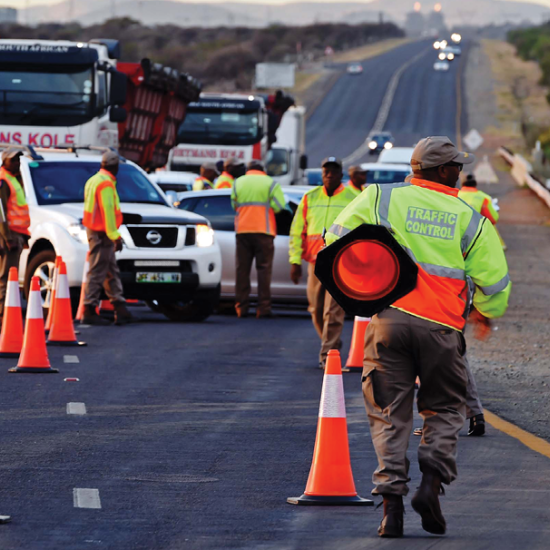
The campaign will include a massive public education and awareness campaign; partnerships with all levels of government and all aspects of civil society; enhanced law enforcement operations, focusing on driver and pedestrian behaviour and 24-hour patrols, particularly in high risk areas.
We will increase roadblocks, checks for vehicle roadworthiness, driver licenses, seatbelt and child-restraint use as well as clamp down on speeding and drunken driving.
The campaign will also focus on public-passenger transport, minibus taxis, cross-border traffic and long-distance travel, all of which historically contribute to major crashes. We will also conduct public transport inspections at depots to stop overloaded and unroadworthy vehicles from entering the main freeways.
We will monitor results and data continuously, and adjust operations in-season, shifting resources to hotspots where needed.
Critical routes
We have identified critical routes that will receive priority attention from our law enforcement officers as these carry high vehicle numbers and are prone to fatal crashes. These include the N1 from Naboomspruit in Limpopo, past Gauteng and the Free State, right up to Laingsburg in the Western Cape; the N2 from Pongola in northern KwaZulu-Natal down to Libode, Idutywa, Mthatha to Maxesibeni in the Eastern Cape.
High risk routes also include the N3 from Gauteng, through the Free State to KwaZulu-Natal; the N4 from Tshwane in Gauteng, through eMalahleni, Mbombela to Komatipoort in Mpumalanga; the R573 between Gauteng and through KwaMhlanga and Siyabuswa in Mpumalanga; the N12 between Gauteng and Klerksdorp in the North West province; the R71 in between Polokwane and Mankweng in Limpopo; the R37 between Mucklenburg and Tubatse in Limpopo as well as the R61 between uMthatha and Ngqeleni in the Eastern Cape.
Collaboration
There will be joint planning of operations through the deployment of traffic officers across borders where traffic volumes peak, high-risk corridors and crash hotspots. A total of 800 law enforcement officers from the National Traffic will be deployed to Gauteng, Limpopo, KwaZulu-Natal and the Eastern Cape, to amplify the existing provincial capacity.
Further collaboration with the Cross-Border Road Transport Agency and the Border Management Agency will focus on public transport points of origin like bus depots, intermodal centres and cross-border transport depots.
Government will step up public awareness campaigns through multiple media and community channels to ensure that road safety messages reach all communities and various road users at train stations, bus and taxi ranks, exhibitions at malls and shopping centres, community halls, churches, toll gates and rest stops, sports events and border posts.
Choose safety
We urge passengers to choose safe public transport options, wear seatbelts and ask their drivers to stop when sensing fatigue. To every driver using the road network, we say, always remember that the most vulnerable user of our roads are pedestrians.
Pedestrians must walk in well-lit areas, wear visible clothing at night, use designated crossings and avoid walking after drinking alcohol.
Government cannot achieve progress alone. We rely on civil society, religious and faith-based organisations, traditional authorities, public transport operators, taxi associations, the private sector, emergency services and every road user.
Several engagements have been conducted with civil society organisations through-out the year to build partnerships and collaborative efforts aimed at reducing road carnage.
The visibility of these organisations in national, provincial and local campaigns is highly commended and has no doubt contributed to the decrease in road fatalities.
We also plead with leaders of the faith and traditional leaders to continue championing road safety education and providing comfort to affected families.
I wish to thank and give courage to the many men and women who will work tirelessly over the coming weeks – our traffic-law enforcement officers, emergency services personnel, road-safety educators, civil-society partners and private sector stakeholders. Your dedication matters.
videos & photos