



Matric class of
2025 makes history
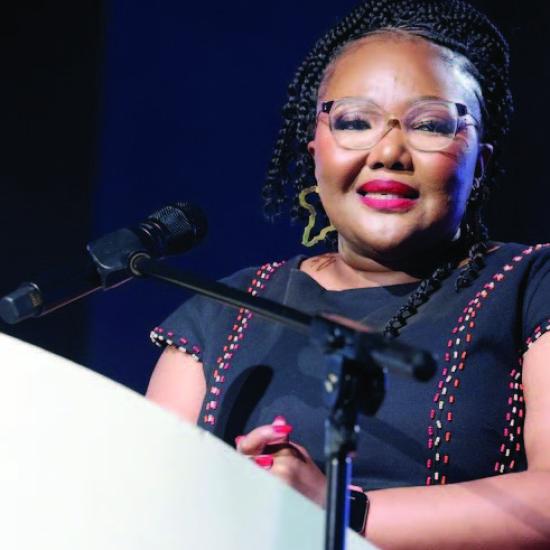
History was made in examination halls across the country in 2025, as more than 900 000 learners – the largest matric cohort on record – sat for the National Senior Certificate (NSC) examinations.
Speaking at the release of the 2025 NSC results in January, Basic Education Minister Siviwe Gwarube said the record numbers is a reflection that South Africa is reaching more learners in Grade 12 than at any point in decades.
“It is a story of resilience: of young people who kept going through difficult seasons. In 2014, 1.2 million children entered Grade 1. By the time that same cohort reached Grade 10 in 2023, a decrease of around 4% was noted,” she said.
She noted that the dropout becomes more pronounced between Grades 10 and 12, as some learners repeat grades while others exit the schooling system altogether. As a result, the full-time Grade 12 class of 2025 stood at around 778 000 learners
This means that the largest dropout pressure is not across the whole system, but it intensifies late as learners progress into Grades 11 and 12.
The Minister pointed out that nationally, only about 84% progress from Grade 10 to Grade 11, and about 78% from Grade 11 to Grade 12.
“If learners exit the system before Grade 12, the system is not yet delivering quality at scale, regardless of how strong the final pass rate is. Where we see lower learner retention alongside higher performance, we must question that pattern carefully and fairly using data, not assumptions,” the Minister added.
A stable system
The data at her disposal also points to a more stable education system, with the largest share of candidates aged 18 – a sign of on-time progression.
At the same time, the proportion of learners unable to sit for any examination papers has dropped sharply, from about 17% in 2017 to just 2% in 2025. The number of part-time repeat candidates has also declined, suggesting fewer learners are returning to repeat Grade 12 as overall performance improves.
“Girls now outnumber boys by 56% to 44%, reflecting stronger protections for the girl child, including the removal of pregnancy as a barrier to education,” she said.
However, the Minister expressed concern that boys are increasingly being left behind, with growing under-representation in matric cohorts and a lower likelihood of returning through second-chance pathways, an imbalance she said requires urgent, targeted intervention.
Key gateway subject
Minister Gwarube said only 34% of candidates wrote Mathematics, with the majority opting for Mathematical Literacy – a trend she described as concerning, given Mathematics’ role as a critical gateway subject.
Despite this, she said the education system continues to grow, although not fast enough in the subjects that strongly shape access to further study, scarce skills and meaningful economic participation.
“A healthy system must grow the number of learners taking Mathematics and Physical Science without sacrificing quality,” she said.
Inclusive education
The Minister also pointed to a remarkable 57% rise in learners with special learning needs sitting the 2025 NSC exams, noting that the gains extend beyond participation to improved achievement as well.
“Significantly more learners with special education needs wrote, passed and achieved admission to Bachelor studies in 2025. The biggest increases were recorded in the Free State and Western Cape. We will continue to work with the other provinces to achieve similar increases” she said.
However, ensuring that South African Sign Language is widely accessible as a language of learning and teaching remains a challenge. With too few trained specialists to teach gateway subjects through sign language, the Minister stressed that this area requires careful attention and targeted intervention.
Social grant beneficiaries
While more social grant beneficiaries wrote the NSC exams in 2025, 78% of them passed, down from 86% previously. That drop, despite more learners writing, is a warning that the Minister needs to be understood and addressed.
The Minister also noted that learners who continued to receive grants outperformed peers whose support had lapsed after turning 18, underscoring just how closely social protection and education are intertwined.
The Minister pledged to work with the Department of Social Development to ensure that no Grade 12 learner loses this vital support during such a pivotal year.
videos & photos