




Gautrain @16: More than a train, a journey that continues to shape Gauteng
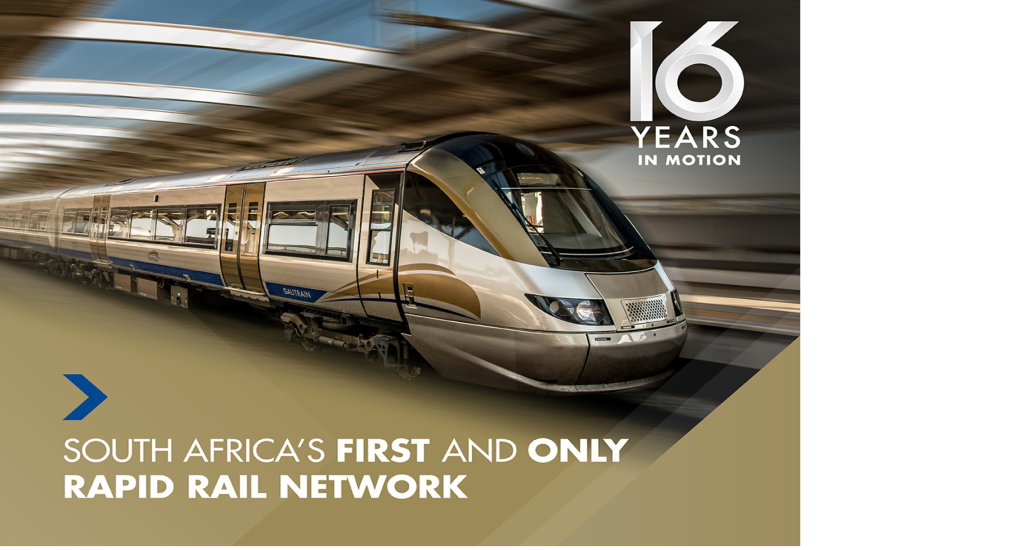
Sixteen years after its launch on 8 June 2010, the Gautrain has become far more than the rapid rail system that first captured the world's attention ahead of the FIFA World Cup. What began as a bold infrastructure project has evolved into a central part of life in Gauteng, connecting millions of people to work, education, business, leisure and opportunity.
Today, the Gautrain marks a significant milestone, with more than 216 million passenger trips since its inception.
The numbers tell an impressive story. The Gautrain's 80-kilometre rail network and 10 stations, supported by an integrated bus and midibus feeder system, continue to move thousands of passengers daily across Gauteng, one of Africa's busiest economic hubs. Yet the true measure of its success lies not only in passenger volumes, but in how it has adapted to the changing mobility needs of the province over the past 16 years.
What was initially conceived as a world-class rapid rail service has evolved into a broader mobility and convenience ecosystem. Innovations such as smart Driver's Licence Testing Centres at selected stations and pioneering partnerships with the minibus taxi industry through the Gautrain Midibus Service have expanded the Gautrain's role beyond rail transport, creating a more seamless and integrated travel experience for passengers.
Safe reliable transport
This evolution reflects a broader shift in how mobility is understood. Increasingly, transport is not simply about moving people from one place to another; it is about connecting journeys, services and everyday experiences. In this regard, the Gautrain continues to play an important role in shaping how people move through, and engage with, Gauteng.
Along the way, Gautrain has challenged some of the misconceptions that surrounded the project in its early years. One of the most persistent was the belief that the service would only cater to a narrow segment of society.
Today, Gautrain's passenger base is remarkably diverse. On any given day, professionals travel alongside students, pensioners, tourists, families attending events and passengers heading to OR Tambo International Airport. What unites them is a shared expectation of safe, reliable and efficient transport.
Leaving no one behind
That commitment to accessibility has become increasingly important. Just over a year ago, Gautrain introduced the KlevaMova affordability product, offering qualifying passengers a 50% discount on train fares. The programme supports households earning R350 000 or less annually, as well as scholars, pensioners and SASSA disability grant recipients.
The response has been significant. KlevaMova now accounts for approximately 11% of all Gautrain passenger trips, highlighting strong demand for affordable public transport options.
Innovative solutions
The system's journey has not been without challenges.
Like transport networks around the world, the Gautrain faced its greatest test during the COVID-19 pandemic. Ridership declined dramatically as people isolated, services were temporarily sus-pended due to lockdown restrictions, and long-established commuting patterns changed almost overnight.
Even after restrictions were lifted, hybrid and remote working models continued to reshape travel behaviour. Traditional weekday commuting could no longer be taken for granted.
Yet the disruption also accelerated innovation. Gautrain broadened its focus beyond business travel, actively catering to leisure travellers, tourists, concert-goers and sports fans. The experience reinforced the importance of resilience, agility and a customer-centric approach to evolving mobility needs.
Attracting investment
The impact of Gautrain extends beyond mobility. Over the years, stations have helped stimulate transit-oriented development and investment in surrounding precincts.
Rosebank provides one of the clearest examples. The area has evolved into a thriving mixed-use district, attracting commercial investment, residential growth and public infrastructure improvements. Similar development patterns can be seen around several Gautrain stations, where reliable public transport has enhanced the attractiveness of surrounding areas for businesses, residents and investors.
For many passengers, however, the value of Gautrain is deeply personal.
While saving time and avoiding traffic remain important benefits, many commuters speak about something less tangible: the experience itself. Time spent reading, working, listening to music or simply enjoying a predictable journey has become a valued part of daily life.
Every trip carries a story. A graduate travelling to a job interview. A student heading to class. A parent commuting to work. A grandparent visiting family. An entrepreneur pursuing a new opportunity.
These everyday journeys are what give meaning to Gautrain's 216 million trips.
One-stop mobility and lifestyle platform
In its next chapter, Gautrain aims to be recognised not only as a rail service, but as Gauteng's one-stop mobility and lifestyle platform – a gateway connecting people to transport, services, business, retail, entertainment and opportunity.
As Gautrain Management Agency Board Chairperson, Professor Mfanelo Ntsobi, notes, Gautrain remains "a lasting legacy of what South Africa can achieve when it invests boldly in infrastructure that serves people for generations.”
Sixteen years on, Gautrain's story is still being written. Behind every trip is a person, a purpose and a destination. As Gauteng continues to grow and evolve, Gautrain remains committed to connecting people to opportunity and ensuring that every journey matters.