




Young PPP specialist building a legacy in public service
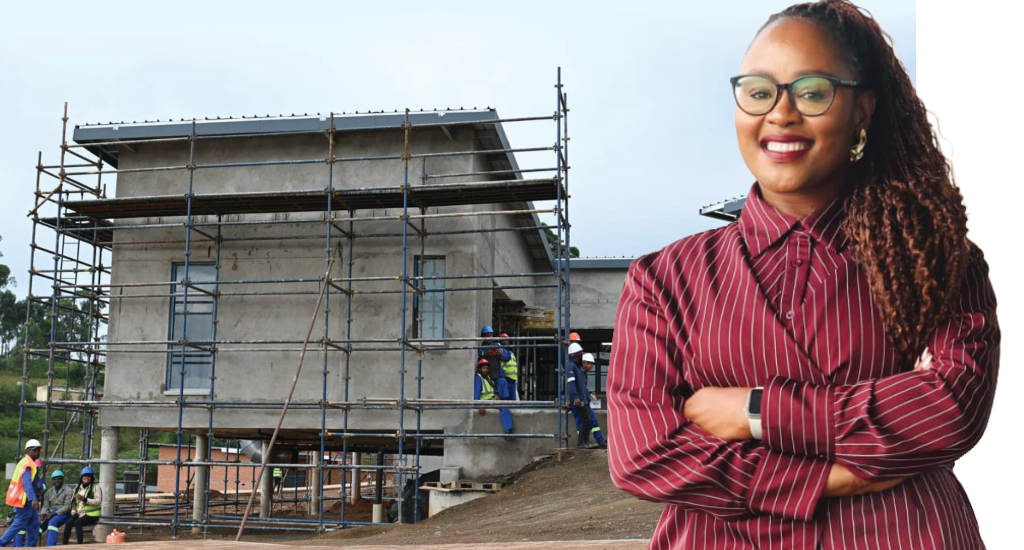
For Yonwaba Mfengwana, success is not just about titles, prestige, or corporate boardrooms, but impact.
In her role as Deputy Director: Infrastructure Finance: Transaction Advisory Services and Public- Private Partnerships (PPP) at Government Technical Advisory Centre (GTAC), she has the opportunity to leave an indelible mark.
A chartered accountant (CA (SA)) since 2021, the 35-year-old advises government on some of the country’s most complex infrastructure and development projects. Her work straddles sectors such as local government, student accommodation developments, financial services transactions, housing finance reforms and strategic infrastructure programmes linked to entities such as state-owned enterprises (SOEs).
In 2025, she was named among SAICA’s 2025 Top 35-under-35 finalists, an honour she says came as a surprise.
Born and raised in the sprawling Cape Town townships of Khayelitsha and Dunoon, Mfengwana always knew she wanted to make a success of her life while observing the hustle of her neighbourhood and learning the resilience of her mother and grandmother.
“I was raised mostly by my grandmother. My mom was a public servant; she worked for DPSA [Department of Public Service and Administration] here in Pretoria. She later worked for a reform school in Worcester. She was always away during the week and back on weekends.”
Entrepreneurial skills
That entrepreneurial instinct emerged early. Like many township children exposed to informal business culture daily, Mfengwana quickly learned to identify opportunity.
“One of the reasons I was very drawn to business is just how the township is – everyone is kind of hustling,” she says.
“Even at an early age, my friends and I had our own salon doing people's hair. I stayed opposite a tavern, so I used to sell snacks and cigarettes. I do not think I was allowed to do that, but I did it. That was the demand,” she chuckled.
Through education, she was able to turn ambition into possibility. Mfengwana attended Table View Primary and Table View High School thanks largely to the sacrifices of her grandmother, who worked as a domestic worker.
“One of the reasons I could go there is because my grandmother somehow managed to convince her employers to pay for my education,” she says.
Those early years also cultivated a deep awareness of politics, governance and public service.
“We watched a lot of current affairs at home and debated it,” she explained, adding that her friends’ siblings, who were at university at the time, would take them to political rallies and debates.
“So I was always aware of what was happening in the public sector and government, and that did intrigue me.”
Inspiration
At one point, she even imagined herself becoming Minister of Education, inspired by the late anti-apartheid activist and former Minister Kader Asmal.
“I actually thought I could study to become a Minister of Education,” she said with a laugh.
Sport also played an important role in shaping her journey. A talented netball player, Mfengwana earned a partial sports and academic scholarship to Stellenbosch University, where she studied accounting.
Yet university was not only an academic experience – it was also politically formative.
“Stellenbosch was also a big influence on me – it is enough to radicalise anyone being there,” she says candidly.
“Accounting back then was offered in Afrikaans. One of the first activism leadership roles that I did take was being at the forefront of changing the language policy, and then being involved in student leadership”.
At university, she initially applied to study accounting and law but settled on the former.
“At registration, the girl I was sitting next to was registered for accounting, and that is how I registered for accounting instead of law,” she recalls.
That choice would ultimately shape the rest of her career.
Joining the Public Service
Between 2014 and 2017, she worked as a real estate analyst at Shell before eventually deciding to complete her articles at the Auditor-General South Africa (AGSA).
Joining AGSA, she said, exposed her to the machinery of the State and some of South Africa’s most influential public institutions.
“That is when my eyes opened to the public sector,” she says.
But it was one particular audit that changed everything.
“What led me to infrastructure and development finance was the DBSA [Development Bank of Southern Africa] audit. That is where you saw what project finance is, what development finance is, the cool things and projects they are working on.”
An investment officer at DBSA later encouraged her to pursue a Master’s in Development Finance. Mfengwana took the advice and enrolled at Stellenbosch Business School, where she completed a Master of Philosophy in Development Finance between 2019 and 2021, focusing her dissertation on PPPs.
Growing through the ranks
Her growing expertise eventually led her to National Treasury, where she served as Deputy Director: Capacity Building from 2021 to 2022. There, she focused heavily on municipal capacity building – experience that would later prove invaluable.
In January 2023, she was transferred to GTAC’s PPP Unit.
Here, Mfengwana is part of a specialised advisory team helping government navigate large-scale infrastructure and transaction projects.
“We basically work with the department or municipality that wants to do a PPP.”
Her work ranges from feasibility studies and procurement processes to financial modelling, stakeholder engagement and the structuring of complex transactions.
“It goes from anything technical, financial modelling, procurement to reviewing PPP agreements to making sure that the government entity is protected.”
Her portfolio has included work linked to Transnet’s rail and ports revitalisation efforts, advisory work for the National Housing Finance Corporation’s transition towards becoming a housing development bank, and even infrastructure advisory work for the African Development Bank in Abidjan, Ivory Coast.
“It has been busy, hectic and stretching,” she said of her tenure at the GTAC.
“But I feel like I am learning so much. These are tangible skills that I can use in the next five to 10 years.”
A passion for service
She speaks passionately about seeing struggling municipalities improve services and gain confidence in delivering projects independently.
“When you go to a municipality that has been struggling with their electricity or energy, and when you leave people have stable energy and the staff are excited about the project and know how to implement projects on their own going forward – that just makes you, as a professional, much richer.”
She says her SAICA recognition highlights a different vision of success for young professionals.
“It is not linked to just money or working for the Big Four firms. It is doing what you love and being able to make an impact”.
She hopes her journey will encourage more young professionals to consider careers in public service and governance reform.
“We need to move beyond just being on the sidelines and be involved in the decisions that are shaping the future,” she says.
“To be able to do that at scale, we need to be involved in government and in the public sector, to be the policymakers, to be the ones who influence the kind of initiatives that are put in place."❖