



CSIR innovations drive
South Africa’s transition to reliable, renewable energy

As winter sets in, electricity demand across South Africa is expected to rise as households turn to heating to keep warm. This seasonal pressure calls for an urgent need for innovative solutions to to ensure uninterrupted power supply.
At the forefront of this effort is the Energy Research Centre at the Council for Scientific and Industrial Research (CSIR), where cutting-edge technologies and forward-looking strategies are helping to stabilise the grid while advancing the country’s transition to renewable energy.
Speaking to Public Sector Manager magazine, Centre Manager, Dr Thabo Hlalele, explained that the CSIR is focused on supporting emerging markets that South Africa can unlock within the energy space. Central to this work is the development of cutting-edge tools and systems aimed at improving efficiency, reliability and sustainability.
One such innovation, developed in collaboration with the CSIR’s sister cluster, NextGen Enterprises and Institutions, is a Solar Artificial Intelligence (AI) Defect Detection tool. This advanced system uses AI to detect solar panel damage that cannot be identified with the naked eye.
The technology combines electroluminescence cameras – specialised diagnostic imaging devices used to detect hidden internal defects in solar photovoltaic (PV) cells and modules – with AI to determine the extent of damage to solar panels with precision.
Unlocking wind energy
Beyond solar innovations, the centre is also contributing significantly to the growth of wind energy. In 2024, the CSIR, in partnership with local and international stakeholders, spearheaded the development of the Wind Atlas for South Africa.
This open-access, high-impact tool maps the country’s vast wind resources, enabling developers, investors and policymakers to accelerate the integration of large-scale wind energy into the national grid. It allows project developers to identify optimal locations for wind farms based on available wind resources.
“This project has essentially unlocked the wind industry in South Africa,” Hlalele said. “We are currently in Phase Four and are exploring opportunities inland. Ultimately, this supports a capable state by providing investors with reliable information, making the renewable energy sector more attractive”.
Advancing energy storage solutions
The Energy Research Centre is also making strides in energy storage, a crucial aspect for managing fluctuations in renewable energy supply.
One of its flagship initiatives is the Energy Storage Testbed, established under the World Bank’s Energy Storage Partnership in collaboration with the Flemish Government and the Flemish Institute for Technological Research (VITO).
Designed to promote energy storage in developing countries, the testbed is helping to transform South Africa’s battery testing landscape through advanced infrastructure and strategic partnerships.
“It provides both reliability and performance testing for batteries, but more importantly, it helps benchmark their performance,” Hlalele explained. “Where South Africa previously relied heavily on imported batteries, we now have the capability to assess whether those products meet our requirements”.
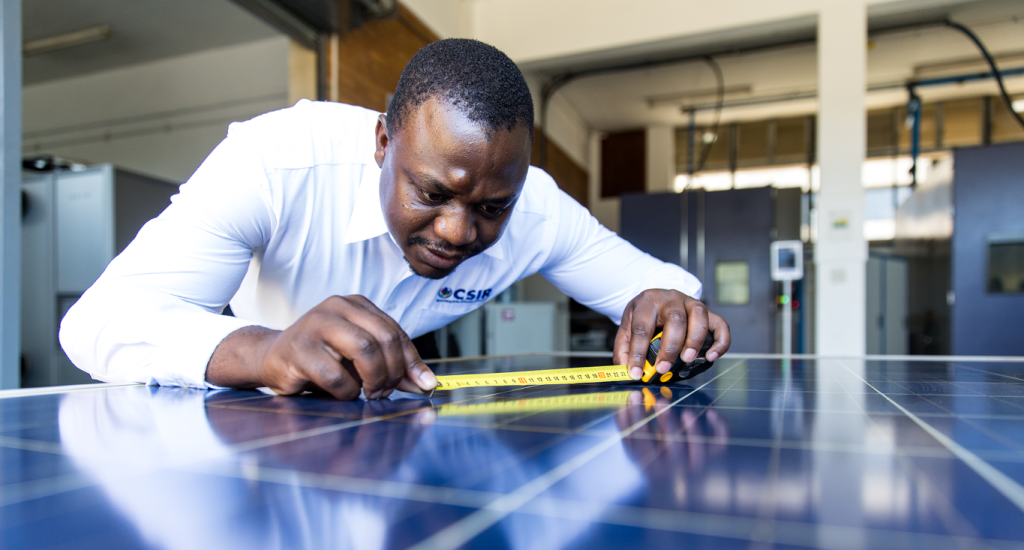
Complementing this work is the CSIR’s PV Module Quality and Reliability Testing Laboratory – the first of its kind in Africa. Equipped with world-class technology, the facility conducts performance, safety and stress testing on PV modules to ensure that only high-quality systems suited to South Africa’s unique climate are deployed.
Hlalele noted that it remains the only accredited laboratory of its kind in Sub-Saharan Africa, positioning South Africa as a leader in renewable energy testing and quality assurance.
Expanding access to electricity
To modernise power systems, improve municipal resilience and advance rural electrification, the CSIR is also developing microgrids – localised, self-sufficient energy systems capable of generating, storing and distributing electricity within a defined area such as a hospital, school or remote village.
Microgrids are particularly significant in the context of South Africa’s energy landscape, where approximately 90.6% of households are connected to the grid, yet issues such as affordability, illegal connections and rapid urbanisation continue to pose challenges.
Hlalele believes microgrids provide a viable solution to bridging this gap while reducing pressure on existing infrastructure.
“Microgrids are among the frontrunners in innovative energy solutions,” he said. “They can reduce the need for large-scale transmission infrastructure while providing reliable, localised power”.
In partnership with the Energy and Water Sector Education and Training Authority, the centre is also nurturing small, medium and micro enterprises (SMMEs) in the energy sector.
Each year, approximately 10 SMMEs participate in a 12-month development programme that equips them with both technical and business skills. Participants are also paired with mentors at the centre to strengthen their capabilities.
The programme focuses on enabling businesses to take advantage of emerging technologies such as solar, wind and battery storage, while building sustainable enterprises within the renewable energy sector.
Now in its third year, the programme is set to conclude in the next two years.
Empowering future engineers
Through a new partnership with the European Union (EU), South Africa is positioning itself as a key player in the global green economy.
The CSIR has been selected to lead the Team Europe Initiative (OP-VET), which aims to develop a world-class battery raw materials value chain while aligning skills development, industrial investment and clean energy innovation.
Originating from the South Africa–EU Clean Trade and Investment Partnership, the initiative will equip young people and women with skills spanning the entire battery value chain – from mining and refining to recycling critical minerals.
“The partnership commits South Africa and the EU to deeper cooperation across the extraction, processing, refining and recycling of critical raw materials,” Hlalele said. “At the same time, it supports decarbonisation, clean supply chains and inclusive economic growth through investment, skills development and job creation.”
The OP-VET project will strengthen Technical and Vocational Education and Training institutions and the broader skills ecosystem to deliver demand-driven, employment-focused training aligned with the battery industry.
It will also support the development of new occupational qualifications, short courses, and work-integrated learning opportunities through partnerships with the private sector – ensuring graduates gain practical experience and clearer pathways into employment.
The pilot phase, scheduled between July and October 2026, will begin in Mpumalanga and the Northern Cape. A limited number of participants will be selected to allow for a focused trial phase and the identification of areas for improvement.
videos & photos