


SA’s labour market
shows modest improvement in Q4: 2025
Statistics South Africa’s latest Quarterly Labour Force Survey (QLFS) for the fourth quarter (Q4) shows that the country’s labour market ended 2025 with some signs of improvement, although some structural challenges remain. While unemployment remains a central concern, the final months of the year presented small but meaningful shifts that signal resilience within the labour market.
A drop in unemployment
The official unemployment rate eased from 31.9% in Q3 to 31.4% in Q4, marking a 0.5 percentage point improvement. The decline reflects two important developments: more people entering employment and a reduction in active job seekers.
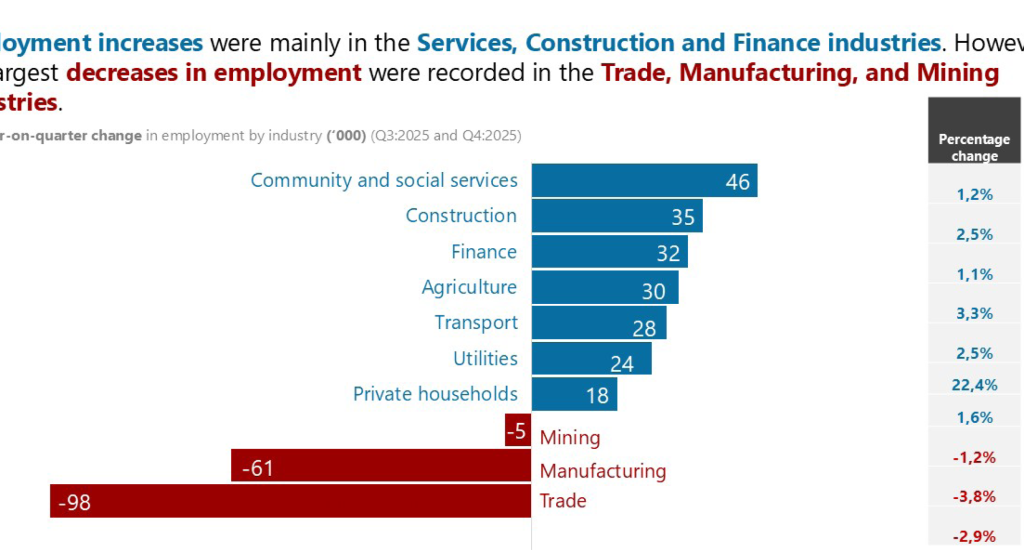
Employment rose by 44 000, bringing the number of employed South Africans to 17.1 million. At the same time, the number of people actively seeking work fell by 172 000, pushing the overall tally of unemployed individuals down to 7.8 million.
These movements collectively contributed to a 128 000 reduction in the labour force, highlighting the complex dynamics influencing household decisions, economic participation and access to opportunities.
The rise of discouragement
The survey also highlighted the rise in discouraged work-seekers, which increased by 233 000 to reach 3.7 million people. These are individuals who want to work but have stopped looking for jobs, often because they have repeatedly been unable to find employment or see few opportunities in their communities.
While other categories of the broader potential labour force declined slightly, such as a drop of 110 000 in other available job-seekers and 41 000 in those unavailable but wanting work, the cumulative effect was a net increase of 82 000 people in the potential labour force. This brought the total to 4.6 million, signalling that growing numbers of South Africans are on the sidelines of meaningful labour market participation.
Outside the Labour Force
The data also shows an expansion of people classified as “outside the labour force” – a group that includes students, the elderly, caregivers and individuals unable or not ready to participate in work.This group increased by 165 000, rising to 12.5 million.
When combined with the potential labour force, South Africa had 17.1 million people outside the labour force by the end of 2025, a jump of 248 000 compared with Q3.
These numbers hint at wider socio-economic pressures affecting households: rising living costs, limited job creation in certain sectors, and uneven access to skills and training continue to shape the labour environment.
A deeper look at labour underutilisation
In addition to the official unemployment rate (LU1), the QLFS provides expanded measures to capture the full scope of labour underutilisation:
- LU2 – unemployment + time-related underemployment: 34.3% (down 0.6 percentage points).
- LU3 – unemployment + potential labour force: 42.1% (down 0.3 percentage points)
- LU4 – the composite measure combining unemployment, underemployment, and the potential labour force: 44.5%
These broader indicators reveal the depth of labour market strain, especially for individuals who may be employed but working fewer hours than they would like, or for those who have stepped back from active job searching but remain available for work.
Balancing the act
The Q4: 2025 labour force results provide a detailed picture of a country working towards economic recovery while confronting entrenched inequalities.
Understanding these trends helps policymakers and public sector leaders design targeted interventions that speak to the lived realities of South Africans. It reinforces the need for coordinated action in expanding training programmes, supporting small enterprises, improving labour mobility and strengthening local economies.
Government response
Meanwhile, government has welcomed the results.
“The improvement in employment reflects the resilience of the South African economy and the impact of targeted interventions aimed at stimulating growth, supporting businesses, and expanding labour market opportunities.
“Government has intensified actions to grow employment through accelerated infrastructure investment to unlock opportunities across key sectors of the economy,” said the Government Communication and Information System (GCIS) in a statement.
The implementation of the Presidential Employment Stimulus continues to provide work opportunities, particularly for young people and women.
“Strengthened public-private partnerships are unlocking new investment and supporting industrial expansion to create long-term employment opportunities.
“Through Operation Vulindlela and ongoing economic reform measures, government continues to remove structural constraints that limit growth, including energy stability and logistics efficiency. These reforms are laying the foundation for sustained job creation,” read the statement. ❖
videos & photos