



Easing the burden
of regulation for SMEs and market efficiencies
The Kearney 2026 Foreign Direct Investment Confidence Index highlights the efficiency of legal and regulatory processes as the second most important factor driving investment intentions in emerging markets.
Recently, the International Monetary Fund (IMF) found that South Africa has one of the most restrictive business environments when compared to its peers, particularly in respect of burdensome government regulations, (including licensing and permitting), weak procurement practices, and limited competition in markets.
The combination of these factors, the IMF argued, can pose risks to business confidence and investment, innovation and increase compliance costs.
More concerning is that this disproportionately impacts small and medium enterprises (SMEs), with negative implications for growth and employment creation.
Reducing red tape
In his 2026 State of the Nation Address, President Cyril Ramaphosa highlighted the need to reduce red tape and improve the ease of doing business – an issue consistently raised in the Competition Commission’s market inquiries and by business stakeholders calling for a more streamlined and modern regulatory system that enables SMEs to enter and expand in markets, as well improving South Africa’s international competitiveness.
Regulations have an important role to play in society and are often necessitated by public policy objectives such as the protection of consumers, health and safety, financial stability, addressing market failures and advancing various developmental imperatives.
However, where such regulations are unduly restrictive or poorly implemented, they can create a burdensome regulatory environment for business, delay entry and constrain SME growth, thus reducing competition, innovation, investment and ultimately jobs.
Regulatory review
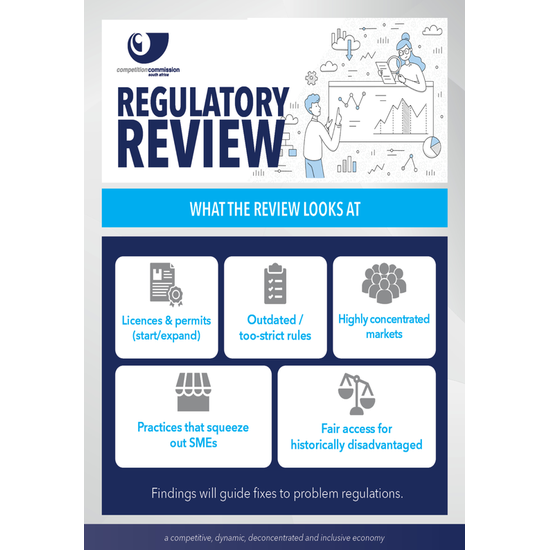
It is within this context that the Competition Commission has launched a regulatory review project aimed at assessing regulations that may act as barriers to competition and the entry or expansion of firms, particularly SMEs in South Africa.
This review project will contribute to the national efforts to support inclusive growth, improve the ease of doing business and strengthen the competitiveness of the economy.
The regulatory review project will identify and assess regulations (including sector policies and licensing frameworks) that may restrict firm entry or expansion and consider whether they are still necessary to achieve their stated purpose or are overly restrictive in design or application and can be modified to still achieve the purpose without posing as a barrier to competition.
The Commission’s 2026 Concentration Tracker Report shows that there remains persistent high levels of concentration across sectors in South Africa. It has been argued that regulatory barriers or licensing practices may maintain concentration levels and work against efforts to reduce concentration in the economy.
As such, the review will also consider whether such regulations adequately address market concentration, the effects of vertical integration on non-integrated firms, potential exclusionary practices, and meaningful participation by historically disadvantaged persons. The insights drawn from the review will inform recommendations for regulatory reforms to modify or remove regulatory barriers to competition and market participation.
By way of illustration, stakeholders previously raised concerns about lengthy approval times and low notification thresholds for mergers in South Africa. The Commission’s assessment of, and response to, the concerns raised was to propose increases to the merger thresholds and commit to reduced turnaround times for merger approvals.
On merger thresholds, the Commission’s assessment showed that 30% of mergers previously notified would no longer require notification and 23% of large mergers would be notified as intermediate, which must be investigated within 60 days, thus significantly easing the regulatory burden on businesses.
Notably, the purpose of merger control would not be undermined as the Commission’s analysis showed that the mergers that would no longer be notified did not raise substantial competition and public interest risks in any event.
On turnaround times, the Commission committed, in its annual performance plan with the Minister of Trade, Industry and Competition, to finalise non-complex mergers within 19 business days, while highly complex large mergers will be finalised within 105 days (as opposed to the previous target of 120 business days).
Have your say
The participation of business (large and small) and other stakeholders, including regulatory bodies, will be crucial in identifying regulations that pose barriers to competition and providing evidence demonstrating actual experiences of how regulations inhibit the ease of doing business in the economy.
It will be important for the development of evidence-based regulatory reforms necessary for the growth of the economy. It is for this reason that the Commission is calling on businesses, and government departments and agencies to make submissions that identify regulatory barriers and motivate for the modification or removal of regulations across the economy. Submissions can be made to regulation@compcom.co.za by 5 June 2026.
The Commission will review these submissions and make an assessment of whether the regulations do indeed pose a barrier and can be modified or removed completely without compromising the objective of the regulation.
The Commission will then publish a report on its recommendations to government for regulatory reforms and advocate for implementation. To ensure there is some urgency in addressing regulatory barriers, the Commission will adopt a phased approach whereby the first report will focus on easily adopted regulatory reforms whilst subsequent reports will tackle those that require legislative and policy changes.
videos & photos