


Advancing the African Agenda and constitutional values
through unity, cooperation and development
This month, we join the rest of the continent in commemorating Africa Month – a time to reflect on our shared history, celebrate our achievements and renew our commitment to Africa’s progress.
It culminates in Africa Day on 25 May, marking the founding of the Organisation of African Unity (OAU) in 1963, now the African Union (AU). The founding of the OAU was a defining moment in Africa’s history, signalling a shared commitment to independence, cooperation and development.
South Africa remains firmly committed to this vision. Our work is guided by the AU’s Agenda 2063 – the continent’s blueprint for becoming a global powerhouse. We support key flagship programmes such as Silencing the Guns, which aims to end wars, civil conflicts, gender-based violence, and genocide. We also support the African Continental Free Trade Area (AfCFTA), which is opening new opportunities for trade and economic cooperation, while also strengthening Africa’s voice in global trade negotiations.
Equally, as South Africa marks 30 years of constitutional democracy, Africa Month in 2026 provides a fitting moment to reflect on the values that underpin our Constitution and the broader African contribution to their realisation. Adopted in 1996, South Africa’s Constitution is rooted in principles of human dignity, equality, freedom, solidarity and social justice – values forged not in isolation, but through deep historical ties with the African continent.
Throughout the struggle against colonialism and apartheid, African countries and institutions played a decisive role in supporting South Africa’s liberation and transition to democracy. This legacy of pan-African solidarity continues to shape our constitutional democracy and informs South Africa’s commitment to advancing peace, development and cooperation across the continent. As we commemorate Africa Month this year, we do so conscious that our constitutional journey is inseparable from Africa’s collective quest for unity, self-determination and inclusive development.
On strides of ensuring a prosperous Africa, we are seeing steady progress in advancing the AfCFTA. South Africa is actively contributing to its implementation, including the finalisation of trade rules across key sectors and the development of protocols that broaden participation; particularly for women and young people. More recently, the introduction of new tariff schedules and duty-free trade measures from January 2026, has begun to unlock meaningful market access opportunities for businesses across the continent.
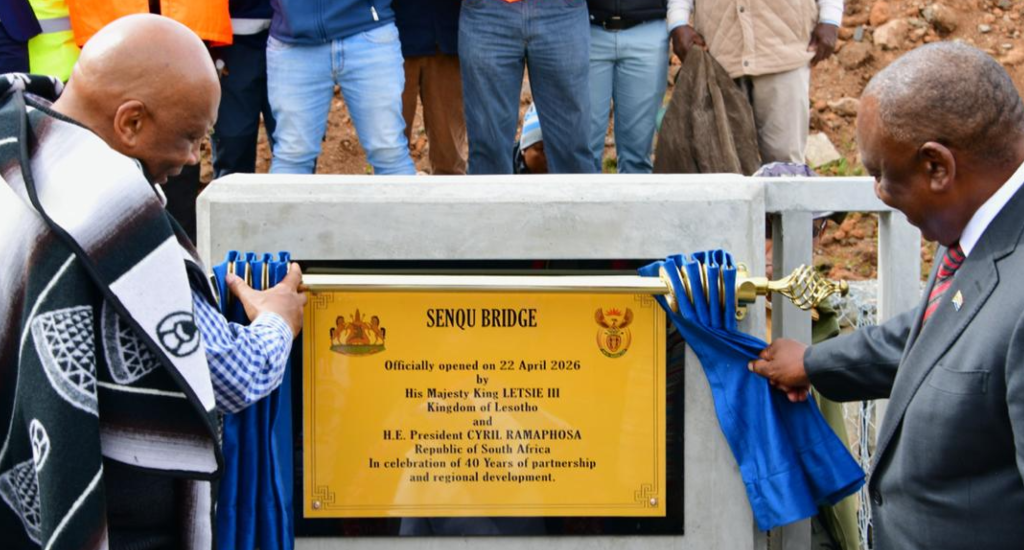
We continue to work closely with neighbouring countries on initiatives that deliver tangible benefits. A recent example is the progress made on Phase II of the Lesotho Highlands Water Project. In April 2026, President Cyril Ramaphosa joined the leadership of Lesotho to launch the Senqu Bridge – an important milestone that will support the next phase of the project and strengthen long-term water security for both countries.
This aligns with the AU’s declaration of 2026 as the year of “Assuring Sustainable Water Availability and Safe Sanitation Systems to Achieve the Goals of Agenda 2063”. The theme elevates water and sanitation as critical continental priorities, recognising their role as key drivers of economic transformation, climate resilience, public health, food security and regional stability.
This project shows what is possible when African countries work together. By pooling resources and sharing expertise, we can pursue development that delivers mutual benefit.
South Africa has also used global platforms to advance African priorities. The country’s G20 Presidency, under the theme “Solidarity, Equality and Sustainability,” reflected the understanding that addressing global challenges requires collective action. In his address at the launch of the Presidency in December 2024, President Cyril Ramaphosa emphasised that South Africa would use its tenure, the first G20 Presidency on African soil, “to bring the development priorities of the African Continent and the Global South more firmly onto the agenda of the G20”.
The theme reinforced an important message: no country can act in isolation and that the voices and interests of developing regions must be more effectively represented in global decision-making processes.
It is the same principle that guided South Africa’s advocacy during the COVID-19 pandemic, when it worked through the AU and various global initiatives to call for equitable access to vaccines, stressing that all countries must have urgent access to ensure global health security.
In his Freedom Day message on 27 April 2026, the President also highlighted the importance of maintaining strong relationships across the continent, reminding the nation of the vital role played by other African countries in South Africa’s struggle against apartheid:
“As a nation that defeated colonialism and apartheid through international solidarity, we carry a responsibility to advance constitutional values beyond our borders”.
In his weekly newsletter message featured in this edition, the President commented on the United Nations General Assembly resolution declaring the trafficking of enslaved Africans and the racialised enslavement of Africans as the gravest crime against humanity. He called for reparations to “be aligned with our continent’s developmental objectives and assist African countries to tackle debt challenges, poverty alleviation, inequality and unemployment”.
These remarks speak directly to the spirit of Africa Month, reminding us that the progress South Africa seeks cannot be separated from the progress of the African continent.
Through its participation in structures such as the Southern African Development Community, South Africa continues to work closely with regional partners to deepen integration, promote peace and security, and advance infrastructure and industrial development across the region.
For public servants, Africa Month serves as an important reminder of the broader context within which we operate. The work we do contributes not only to national development, but also to the achievement of shared continental goals.
Africa Month reinforces the understanding that building a capable state, a growing economy and an inclusive society is directly linked to the broader goal of building a better Africa.
As we celebrate Africa Month during the 30th anniversary year of our Constitution, we are reminded that South Africa’s democratic project is deeply interwoven with the destiny of the African continent. The constitutional values we uphold at home – non‑racialism, human rights, accountability and social justice – find expression in our commitment to African unity, multilateralism and sustainable development beyond our borders.
Africa Month, therefore, calls on all public servants to situate their work within this broader historical and constitutional context. By advancing a capable developmental state, strengthening regional cooperation and contributing to the goals of Agenda 2063, we honour both the spirit of our Constitution, and the enduring support Africa has extended to South Africa’s freedom and progress. In doing so, we reaffirm a shared responsibility to build not only a better South Africa, but a better and more prosperous Africa for future generations.
videos & photos