



Dr Praveena Sukhraj-Ely
is a powerful symbol of possibility for persons with disabilities
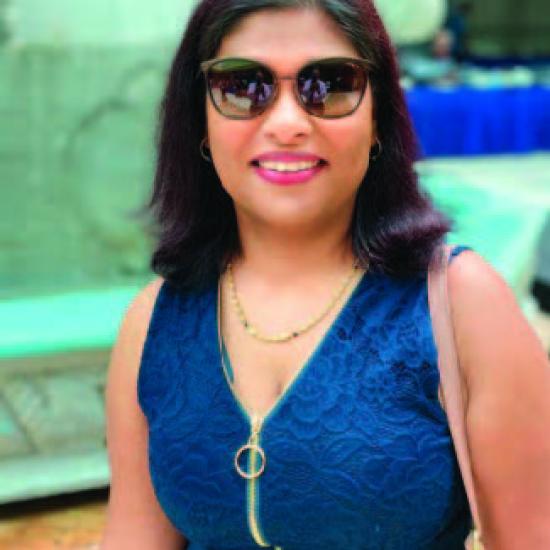
Dr Praveena Sukhraj-Ely is a powerful symbol of possibility for persons with disabilities
As South Africa marks National Disability Rights Awareness Month from 3 November to 3 December, Dr Praveena Sukhraj-Ely's appointment as Acting Director-General (ADG) of the Department of Women, Youth and Persons with Disabilities (DWYPD) stands as a powerful reminder of how far the country has come in advancing the rights of persons with disabilities, and how much work remains.
In July, Sukhraj-Ely became the first person who is totally blind to lead a national government department. A legal practitioner, public policy expert and disability rights advocate, she sees her appointment not as a personal achievement, but as an opportunity to challenge stereotypes and expand opportunities for others.
National Disability Rights
Awareness Month culminates in the International Day of Persons with Disabilities on 3 December and aims to encourage action to remove barriers, challenge stigma and improve the quality of life of persons with disabilities.
As the department responsible for driving government's equity, equality and empowerment agenda for persons with disabilities, women and young people, the DWYPD is at the centre of that effort.
Ahead of the commemoration, Public Sector Manager magazine sat down with Sukhraj-Ely to discuss her journey.
Taking up the reins
Although she has spent much of her academic and professional life advocating for the rights and inclusion of persons with disabilities, Sukhraj-Ely never imagined that she would one day lead a national government department.
“I never dreamed that one day I would hold this position, even in an acting role as a DG, because I understand the stereotypes, the stigma and prejudice, and bearing in mind that this is the highest level that you can occupy as a civil servant.
“To be trusted with accounts, figures and to lead the entire national department as a blind person is something that I do not take lightly,” she said.
She emphasised that her advocacy has always centred on ensuring that persons with disabilities can access employment, become entrepreneurs and participate meaningfully in the country’s development.
Sukhraj-Ely remains concerned that society still expects leaders to look, walk, act and make eye contact in a particular way before they are deemed fit for certain positions.
While her appointment is a significant milestone for persons with disabilities, Sukhraj-Ely is determined not to be viewed as an exception to the rule. Instead, she hopes it will become part of a broader shift towards recognising the capabilities of persons with disabilities and removing barriers to leadership.
Advancing inclusion
The ADG called on South Africans to create an environment in which persons with disabilities can thrive. For too long, she said, many have been excluded, isolated and treated differently because of their disabilities.
She believes her appointment signals growing confidence in the leadership potential that exists within the disability sector and hopes it will encourage other institutions to broaden opportunities for persons with disabilities.
“This step, I am hoping, will make other departments move in a similar direction by not only employing persons with disabilities but also putting them in leadership positions so that when we say ‘nothing about us without us’, our word and what we speak holds water,” she added.
While awareness of disability rights has improved over the years, Sukhraj-Ely believes the focus must now shift towards practical change that improves people's daily lives.
“We need to focus on ensuring that the awareness that we raise is more practical as we move forward. This needs to be practical and not just high-level talk about awareness, it must speak to everyday lived experiences, the exclusion and segregation that is felt by persons living with disabilities so that people can change their mindset regarding disability rights. We also need to raise awareness among people living with disabilities so that they understand their rights and are empowered to exercise them,” she said.
A journey of perseverance
Like many persons with disabilities, Sukhraj-Ely's path to leadership was shaped by perseverance, determination and a refusal to accept barriers placed in her way.
Originally from Durban in KwaZulu-Natal, she attended Arthur Blaxall School for the Blind in Pietermaritzburg, where she matriculated in 1995.
She holds four degrees, including a Bachelor of Social Science, a Bachelor of Laws, a Master of Arts in Political Science awarded cum laude and a PhD in Public Policy from the University of KwaZulu-Natal.
Career journey
Sukhraj-Ely has extensive experience in governance, constitutional law, disability rights, gender-based violence and femicide (GBVF), public administration and policy development.
She also serves as the State Representative on the Commission for Employment Equity, where she advocates for a 7% disability employment target by 2030.
She is among the leaders driving the implementation of the Domestic Violence Act of 1998, the development of the Femicide Strategy, and the drafting of the Disability Access to Justice Policy.
Her appointment as ADG is the culmination of years of advocacy, public service and work to advance the rights of women, older persons and persons with disabilities.
Reflecting on her journey, she recalled the difficulties she faced entering the job market despite her academic achievements and professional credentials.
A bumpy ride
“It seemed like nobody wanted to employ me despite the fact that I got called to many interviews and I had Golden Key
(an international student honour society), various Deans' commendations and 19 distinctions... but no one in the private sector wanted to employ me,” she said.
At the age of 24, she registered for pupillage at the Durban Bar to qualify as a practising advocate. She later established a private practice and worked as an Advocate of the High Court of South Africa from 2003 to 2006, before joining the South African Law Reform Commission as a Senior State Advocate.
She later served as in-house counsel in the Chief Litigation Office at the Department of Justice before being promoted to Director responsible for Domestic Violence, Femicide, Older Persons and Persons with Disabilities.
Between 2014 and 2022, she focused on protecting and advancing legislation affecting women, persons with disabilities and older persons, particularly in relation to GBVF and access to justice. In 2022, she was appointed Chief Director for Governance and Compliance at the DWYPD.
She has also served on various national and international boards in a voluntary capacity, including the South African National Council for the Blind, where she was Vice Chairperson and Chairperson of the Children with Disability Training Sector. She is currently the second Vice President of the South African Federation for Mental Health and previously served as Vice Chairperson of the South African Disability Alliance.
Internationally, she has served as Vice President and now Treasurer of the International Council for Education of People with Visual Impairment. She is also Co-Chairperson of the Accessible Books Consortium and a member of the International Disability Alliance Inclusive Education Task Team.