



Three years of South African Sign Language: Making inclusion a reality
This year marks three years since the officialisation of South African Sign Language (SASL), a great achievement in our constitutional democracy and a milestone worthy of recognition and celebration. However, as we acknowledge this historic milestone, we must also take stock of what has been done across different sectors to give practical effect to the officialisation of SASL. The real measure of its impact will be an improvement in the lived reality of the Deaf community, with meaningful access to quality information and services.
We must ask a fundamental question of what it means for a language to be official in the country. Can a member of the Deaf community go to their local clinic or police station and be assisted in SASL? Can they access banking services, engage with government departments or access critical information in their own language? These are not luxuries but fundamental aspects of everyday life essential to every citizen in our constitutional democracy.
Many hearing people take for granted the ability to switch on the television in the morning and watch the news. We listen to the radio on our way to work, hear traffic reports and adjust our routes accordingly. We receive emergency alerts, follow public announcements and engage with information as it unfolds around us.
Are you doing your part?
For the Deaf community, access to information relies on the intentional measures society puts in place to ensure they have access to quality interpreters, information and services. Their access to quality information is contingent on the availability of qualified SASL interpreters, appropriately accessible content and communication platforms that recognise the needs of Deaf people.
Often, institutions fall short of making provision for these requirements, leading to many challenges for the Deaf community. When these systems fail, the consequences are significant. A lack of access to timely and accurate information can affect a person’s ability to make informed decisions about their health, safety, education and meaningful participation in society.
Through our work, we encounter stories that remind us that language access must begin long before a child enters a classroom. Consider a Deaf child born to hearing parents; in many such cases, no one in the family knows SASL. The child may only encounter the language when they start school, where they can learn a way to communicate and feel heard and understood. The experiences of Deaf children during the Covid-19 lockdown brought this reality into sharp focus. Many Deaf learners experienced isolation and exclusion because their homes did not provide the same linguistic environment and sense of belonging they experienced at school. For some, school was not merely a place of learning; it was a place where they could communicate freely and be heard.
Supporting Deaf people and their families
This highlighted the critical gap that exists in the support provided to parents and families. When a Deaf child is born to hearing parents, families should not simply be sent home without the knowledge, resources and support they need to communicate with their child. Early language acquisition is essential to a child’s cognitive and social development. Families should therefore have access to the SASL training and appropriate guidance from the earliest possible stage. The goal should be to ensure that a Deaf child does not have to wait until school to first encounter the language.
Equally important is recognising the needs of Deaf parents raising hearing children. In many cases, hearing children become informal interpreters for their Deaf parents from a young age. They may be expected to interpret conversations with government officials, teachers and doctors, which can place children in situations that are inappropriate for their age and expose them to adult conversations that should never be their responsibility.
Parents should be able to communicate independently and privately without relying on their children as interpreters. This requires all sectors of society to collectively take responsibility for providing appropriate, high-quality interpreting services.
From recognition to implementation
The officialisation of SASL was a powerful statement of intention about equality, dignity and inclusion. But recognition is only the beginning; the next phase must be about implementation. Government, civil society, business, the media, educational institutions and other sectors of society all have a role to play in ensuring that SASL is not merely an official language on paper, but a language through which Deaf people can fully participate in society.
This means strengthening the availability of qualified interpreters, expanding accessible public information, improving digital and broadcast accessibility, equipping frontline public servants with basic SASL skills, and ensuring that essential services are designed with Deaf people in mind. This also means listening to Deaf people themselves. Policies and programmes intended to serve the Deaf community must be developed with their meaningful participation and informed by their lived experiences.
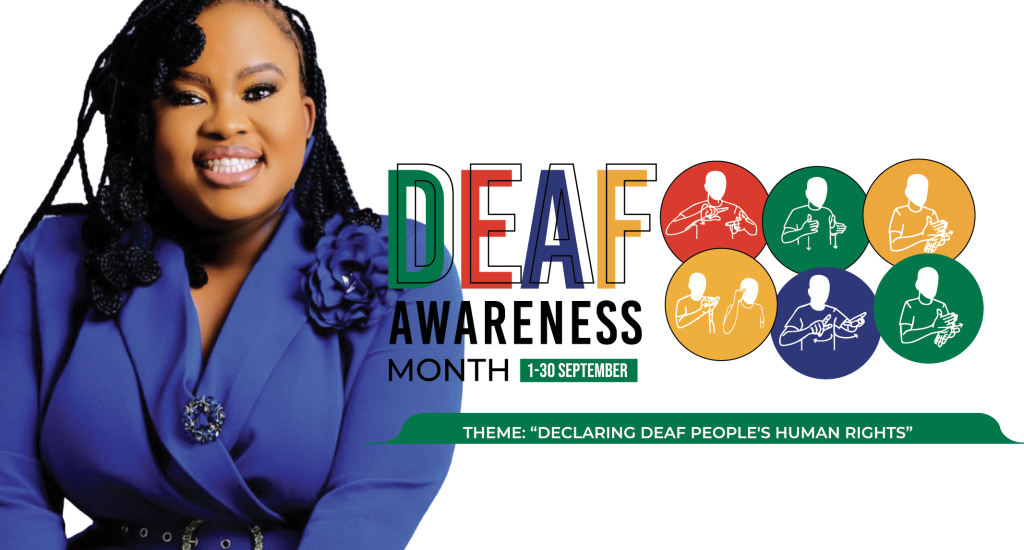
As we observe Deaf Awareness Month and reflect on three years of SASL as an official language, our message to government, civil society and every sector of society is clear: the work cannot stop at recognition. The President has recently signed the proclamation initiating practical measures to use and develop SASL. Three years on, we have every reason to celebrate how far we have come. But we must also reflect on how far we still have to go to achieve meaningful inclusion for the Deaf community. Our collective responsibility now is to ensure that Deaf people can experience the full meaning of that official status in every sphere of their lives. ❖