




A heritage journey to humanity's origins
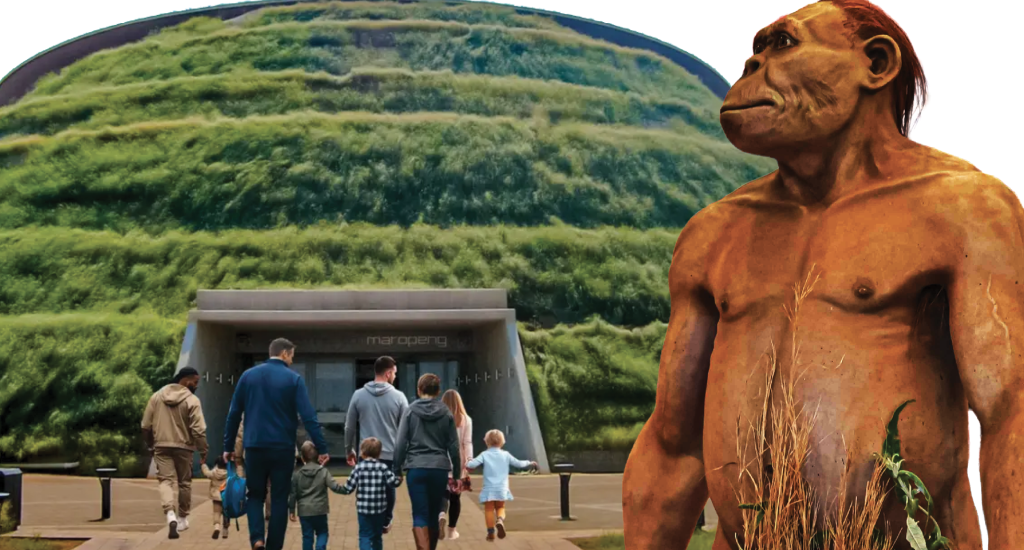
What begins as a short drive to the Cradle of Humankind soon becomes a journey through millions of years of history, revealing the discoveries that continue to shape our understanding of humanity.
Few places on Earth offer a window into humanity's distant past quite like South Africa's Cradle of Humankind UNESCO World Heritage Site. Recognised by United Nations Educational, Scientific and Cultural Organization (UNESCO) – a specialised United Nations agency that promotes world peace and security through international cooperation in education, arts, sciences and culture in 1999, this remarkable landscape ranks among the world's most significant palaeoanthropological treasures.
Stretching across 47 000 hectares of rolling grasslands and rocky outcrops northwest of Johannesburg, the site conceals an extraordinary network of limestone caves beneath its surface. These ancient caves have yielded some of the world's oldest hominid fossils, helping scientists piece together the story of our earliest ancestors.
Over the years, researchers have uncovered more than 1 000 hominid fossils and identified several hominid species at the site. Hominids are a family that includes humans and their direct ancestors, and the Cradle of Humankind is the richest treasure trove of early hominid fossils on Earth.
In August, I visited Maropeng, the official visitor centre of the Cradle of Humankind, for a two-day exploration of this remarkable heritage destination.
The drive from Hatfield in Pretoria took just over an hour, making it an easy day trip for visitors from both Pretoria and Johannesburg.
As I approached Maropeng, the urban landscape gradually gave way to open grasslands and rolling countryside. It was hard to imagine that beneath this tranquil setting lies a record of human history stretching back millions of years.
As visitors draw closer to Maropeng, a striking structure rises from the landscape. Designed to resemble a tumulus, an ancient burial mound, the building appears to emerge naturally from the surrounding grasslands, blending architecture, history and nature in a single bold statement.
After checking into the four-star Maropeng Boutique Hotel, I took a moment to soak in the tranquillity of the setting. Framed by rolling hills and expansive views, the hotel offers a peaceful retreat from the fast pace of city life. The warm welcome from staff and the inviting atmosphere set the tone for the experience that lay ahead.
An hour later, refreshed and eager to learn more about the region's extraordinary past, I made my way to the iconic tumulus. There, I met Lindiwe Mahlangu, Maropeng's award-winning heritage interpreter and public programmes specialist, who would guide me through a journey spanning millions of years of human history.
A journey through time
The atmosphere felt calm and almost spiritual. I imagine many visitors experience the same sense of reflection when they arrive. Standing there, surrounded by a landscape that holds the story of our origins, it was difficult not to feel connected to something much larger than oneself.
From the moment the experience begins, visitors are taken on a journey through time, tracing the history of the universe from its beginnings some 14 billion years ago to the present day and beyond.
Prior to entering the tumulus, visitors pass through a welcome centre with cafés, food outlets and craft shops. Nearby, a wall bears the names of the people who were present when the landmark building was opened.
Before entering the main exhibition area, I boarded a boat that glided through a man-made underground waterway. The ride serves as an introduction to the Maropeng experience, taking visitors through key moments in the formation of the Earth and the evolution of life. It was both entertaining and thought-provoking, setting the tone for what lay ahead.
Inside, interactive exhibits, multimedia displays and fascinating artefacts bring the story of human evolution to life. Visitors can spend hours exploring the exhibitions, which not only reveal humanity's origins but also encourage reflection on its future.
As Mahlangu guided me through the displays, interpreting the fossils, artefacts and visual narratives before us, I felt as though I was travelling through millions of years of history. Each stop revealed another chapter in the remarkable story of human evolution and the discoveries that continue to shape our understanding of life on Earth.
All visitors are welcome
Whether you are a curious traveller, a student eager to learn, a family seeking an educational outing or a history enthusiast, Maropeng offers an opportunity to engage with one of humanity's most fascinating stories.
The Cradle of Humankind is home to more than a dozen major fossil sites. Because many of these sites are not open to the public, the Maropeng Visitor Centre was created to introduce visitors to the area's global significance and to tell the story of human evolution in an accessible and engaging way.
Mahlangu explained that Maropeng became the official visitor centre of the Cradle of Humankind in 2005. Since then, it has welcomed visitors from around the world and continues to play an important role in preserving and sharing South Africa's rich human heritage.
A short drive from the tumulus, Mahlangu showed me one of the venue's outdoor event spaces, set against the backdrop of the surrounding landscape. The site hosts a range of gatherings, including heritage celebrations, retreats, year-end functions and other outdoor activities. It can accommodate up to 700 guests. Nearby is an amphitheatre with capacity for more than 30 000 people, providing a dramatic setting for large-scale events and performances.
Learning comes to life
Maropeng also plays an important role in education. Learners and students can visit the centre on day trips or participate in longer educational programmes that extend over several days.
Mahlangu said between 70 000 and 90 000 learners and students visit Maropeng each year. They come from schools and tertiary institutions across South Africa and other parts of the world, drawn by the opportunity to experience one of the world's most significant heritage and research sites firsthand.
This complements subjects such as Life Sciences, Tourism, Hospitality Studies, History and Geography. It also gives learners an opportunity to experience concepts from the classroom in a real-world setting.
Learners often visit Maropeng as part of organised educational tours. While some groups spend only a day at the centre, others stay for several days, either to explore more of Gauteng or to participate in extended learning programmes linked to their curriculum.
To support these programmes, Maropeng has dedicated educational facilities that include a lecture hall, a marking centre, conference venues, a restaurant and dining areas. Learners stay in dormitory-style accommodation, while teachers are housed in a separate six-room lodge-style facility.
The centre can accommodate up to 120 learners at a time. Larger groups can also be hosted through additional overflow facilities. The broader Cradle of Humankind area offers about 2 500 beds across a range of accommodation establishments, making it possible for visitors to extend their stay and explore the region at a leisurely pace.
Maropeng's contribution to heritage tourism has earned it international recognition, including the 2025 Excellence in Tourism Award at the Global Tourism Excellence Awards.
As the afternoon sun settled over the grasslands and the pace of the day began to slow, it was easy to understand why the Cradle of Humankind continues to captivate visitors from around the world. What begins as a journey into humanity's distant past becomes an opportunity to reflect on who we are, where we come from and the legacy we will leave for future generations.